Reflection: Why Should I Blog?

Blogging Messy House

The other day, it took me 3 hours to write/revise/edit/publish a blog post on my Literate Mind blog.  It was only a book review, for Pete’s Sake.   I DID have some internet issues and my typical distraction problems.  Seriously, though.  I’m spending way too much time trying to create some words and put them out there for the world.  I have dishes to wash. Laundry.  Rooms to declutter.

So, I got out my notebook and did some serious reflecting.  I asked myself the question that I have began to ask myself with every blog post.

“Why am I doing this?  Why should I blog? What are the benefits of this?  Am I nuts?”

Boy, did my pen have something to say.  Words began to flood onto the page.

Here are 5 reasons (of the many) of why I blog:

1.  I am a teacher.

Not only do I teach kids how to write, but I work with teachers in guiding them to be teachers of writing.  The first must of a writing teacher is that the writing teacher must be a writer.  A pilot instructor would have to know how to fly planes, right?

I’ve always scribbled words in notebooks, diaries, and journals.  I’ve written in front of kids to model writing workshop lessons.  I wrote.  But, still, I did not call myself a writer.  Only real authors could declare themselves a writer and wear that title. Here I was, a teacher for 20+ years and a literacy coach and still, I could not call myself a writer.  Was I worried this was vain?  Did I fear others would think I was lying?  They would surely ask me what I had written if I said I was a writer. And then, judge it, of course.  Ugh.  All of this was just too risky.

What a hypocrite, I was.

Then, in 2012, I signed up for a free e-course by Jeff Goins, called  YOU ARE A WRITER.  Jeff taught me how to say these words:


“You are a writer.”


“Say them out loud,” he said.

“Write them down.”

” Tell someone.”

So I did.

And, so I was.

The blog was born as a result of claiming I was a writer.  Jeff said that if you are a writer, you have to start acting like one. This meant sharing your writing and building a community.

I guess I had to follow through if I was going to say I was a writer.


2.  More valuable that any writing program, I have curriculum to draw from within my own experiences.

I’m in the trenches with the kids and other teachers of writing when I blog.

Mem Fox, in her book, Radical Reflections, writes:

“Teachers of writing who have been soldiers themselves, engaged in a writing battle, are able to empathize more closely with the comrades in their classrooms than teachers who are merely war correspondents at the hotel bar, as it were, watching the battle from a safe distance, declining to get in there themselves and write.”

I didn’t want to be a teacher who sat at the bar, too afraid to practice what I was preaching.

I now know what kids and teachers go through when they try to write.  The fear.  The frustration.  The battle.  This battle can not come when we keep our writing hidden from others, in a notebook.  Notebook writing is easy, as this is first draft writing or jotting down ideas.  It becomes real when we know we are writing for someone other than ourselves.  Then, we have roll up our sleeves, get dirty and then,  clean it up.

I can teach how I find ideas to write by sharing what I do:   noticing what’s happening around me, the words others’ say, topics I deeply care about.  I can teach how to write that perfect lead, because I wrestle with it and have a few tools for this along with some favorite leads from mentor texts.   I can draw from my toolbox, a lesson that teaches others how to edit for themselves and I can model my methods for this, because I’ve done it myself.

I stand on the shoulders of writing teachers; Donald Murray, Donald Graves, Lucy Calkins and Katie Wood Ray.  They are my guides. Basically, nothing I teach is my own idea – these methods came from someone before me.

I’ve used their methods, tried them out and have internalized them as my own methods now.  Will they work for every writer?  No.  I read, listen to other writers and to the kids of how they write and their methods get thrown in my toolbox, as well.

My own toolbox is more valuable that any writing curriculum.  No writing curriculum is perfect as it leaves out the most important factor:  the kids.  If it’s all you have to follow in the teaching of writing, you will be frustrated.   And, I can draw from my own toolbox at anytime, anywhere.  If one tool doesn’t work, I try another.  I’ve tried them all, so they are etched in who I am as a writer.

3.  I’m starting to live my life differently because of my blog.

I notice things with meaning and get it down.  I take time to reflect on, not only events, but on my response to them.  I nudge myself to reflect deeper, to get to the other side, to allow new learning to bubble up, something of significance and to make it clear for me to understand.  I do this for me, but more so, for my audience (even if it is only my mother – thanks, Mom).

A car trip, a walk in the woods, shopping at the grocery store, sitting at the lake, and visiting with people are all free fodder for writing. I find myself thinking not only, “I’ve got to write this down,” but also, “Oh my, I need to write this for ______.”

If I need to write clearly for an audience to understand my thinking, I’d better be pretty clear of it myself.

I could not have done this without a blog.

4.  Blogging has been an avenue in which to use the tool of writing to serve my higher purpose.

I don’t think that writing is a  purpose or a calling.  It’s just a tool to use.  If you are called to teach?  Write.  Called to heal?  Write.  Called to inspire?  Write.  Called to serve, help others, beautify the world, create, coach, energize, collaborate?  Then, write, write, write.  There is no better tool that can reach more people than writing.  But, only if you put it out there for the world.

5.  It just feels good.

There is a sense of accomplishment and surge of satisfaction I feel every time I hit publish.  I am jolted with a little shot of dopamine upon seeing those words,   “Your post has been published.”

And, then, I do a little happy dance.

Getting it down is the easy part.  Revision and editing is hard work.  Never, would I revise and edit in my notebooks.  Blogging makes you do this.

I’ve had to learn to choose timely topics and ones that matter.  I’ve had to figure out how to stick to a topic and focus.  I tend to stray in my notebooks, but I can’t do that on a blog.

I strive to find ways to improve in my craft by reading books about writing, joining some writing groups online and taking classes about writing.  I know what I struggle with in my writing and have learned to appreciate criticism.  Always, I can get better at this.

When we know more, we do better and we gain confidence.

And, this just feels good.


Okay ~ I guess the rewards are worth the battle.  Whew.

The only drawbacks are that my house is a mess.  But, it was a mess before I started blogging, so I guess I can’t use that as an excuse.

Maybe I should blog about that.

What are the reasons you blog?  Please, let me know.


Shari 🙂


Listening Lesson #1: Pay Attention

Image

Earlier this week, I was reading a thought provoking post by A.J. Juliani titled the Power of Writing Every Day, and some of his words stuck with me that I could not shake loose, so I had to write about them.

He wrote:

Instead of focusing my blog as only a place for reflection (which it sometimes is) I’ve tried to make my posts as useful and helpful for other teachers, writers, and learners as possible. Really, I try to teach with my blog as much as possible.

Thinking about my own blog posts, I began analyzing how many were reflection posts and how many were teaching.  There are probably too many reflection posts, as I use my writing for reflection, although, we also learn from these reflections, so sometimes, reflection and learning go hand in hand.

The voice of self-doubt then started to creep in and by the time I’d spent a more than adequate time thinking about it, I’d convinced myself that I spend too much time thinking about what to blog about and then actually choosing a topic for my blog to blog about and then wrestling with the content of the blog, revising, editing, etc. . . that by the time I’d finally spent a half a day with a post and hit publish, was the whole mess even worth it?  I mean, reflection or teaching ~ what’s it matter if no one reads the dang thing anyway?  Seriously, the only one who benefits is me, because maybe I learned from it.

I sat there. Defeated.

Suddenly, a pillow of smoke arose in front of my eyes at my desk.

My candle had decided to go out.

This was strange because there was plenty of wax in there to keep that candle going.  But, at that precise moment, it died.

As I looked at the candle, the “Message from My Angel” card sitting next to the candle hooked my attention.  It’s message:

You have an important life purpose involving communication and the arts.  Please don’t allow insecurities to hold you back.  I will help you.

Archangel Gabrielle ~ the angel of communication sits at my side.  She is a constant reminder to keep going.

And the candle? It’s message:

Don’t let your dream die out and go up in smoke.

It’s this kind of listening that guides me in the direction to go each day. This stillness of the mind that allows me to pay attention to the quiet whispers God is sending me is a constant conscious effort every moment of my life.  I often let my mind do all the thinking and get lost down the wrong path.  On days that I allow to unfold naturally, these messages appear constantly. They uplift my spirit and give me inspiration and courage.

Paying attention takes practice.  Most of us are rarely paying attention because we have so much on our minds and when we don’t, we reach for technology to occupy it.  These are distractions that keep us from the signs we are meant to notice.

Today, I challenge you to be still and pay attention.  You don’t need your phone with you in the bathroom.  Quit checking facebook. How many email messages do you expect to receive in an hour – do you really need to check every five minute?  Just unplug for awhile and breathe.  Your listening skills will improve and before you know it, you won’t be searching online for the answers to your questions, you’ll just be sitting still to hear them.

Shari 🙂

Where Writing Comes From

IMG_3845

Awakened by a high pitched whine outside my bedroom door, I cover my head and burrow back into my flannel sheets and quilts.  Saturday mornings are reserved for sleeping in past 6:30, but being the lone human at home this morning, it would be my duty to wake up to Sandy’s calling.

As I shuffle to the biffy first, Sandy follows me.  I sit down and and I receive morning kisses – dog licks on my chin and nose.

“Yes, yes, I’m happy to see you, too,” I smile.

After this reassurance, she rushes into the bedroom to see if her master is awake.  She returns after noticing his absence.  Ice fishing called his name this weekend and Sandy was left behind.  Up and down the hallway she paces.

“Wanna go outside?” I ask her.

Her tail wagging in gear three and jumping means an absolutely “YES!”  Opening the door, she bursts out, galloping over to the woods.

“Sheesh!” I mutter to myself, shaking my head. “How can she be so wound up in the morning?”

I venture off to the kitchen to make some coffee and wrinkle my nose in disgust.  Dishes fill the sink and tracings of yesterday clutter the table.  A full day yesterday at work and exhaustion upon arriving home meant a little reading and right to bed for me.  I pay the price today.

“You need to get this cleaned up before you start anything,” Bernice scolds.

“Well,  it’s going to have to wait,” I tell her, “I have writing to do.

She frowns.  I’m getting really good at talking back to my ego mind.

I fill my cup with coffee and head up to my sanctuary, having no idea  what I might write about today.  However, I know, from daily writing, that if I show up to write, something will come.

A candle is lit. My inspiration playlist gently fills my ears.  I rustle through my pens to choose the perfect one that wants to write for me today.  My notebook opens to a blank page.

Okay. I’m ready.

And, I sit.

My eyes close and I breathe, hand placed over the page.  Deep breaths, breathing in this moment.  Stillness.

“Give me something – something. . . ” I ask.

The trees outside are swaying wickedly as I gaze out the window above my desk.  The sun pops in and out of clouds.  The light so bright I have to squint my eyes.

“Wow! I have not seen that much brightness for awhile!” I say to myself out loud, the spring sun a gift.

The heat kicks in.  A vent on the floor to my right forces warmth up my way.

“M-m-m-m-m . . . this is heaven. . . the sun, the heat.”  I savor it.

Adelle’s turn to sing on my playlist.  Her words?

“Make you feel my love. . .”

I breathe again.  Angel arms wrap around me.  I shut my eyes and smile, a tear squeaking out, feeling His greatness.

“Thank you.  Yes,” I praise.

And, I put my pen to the page.

Notice, Name It and Pay A Compliment

Image

“Learning to compliment others well is a real art. . . receiving any kind of positive feedback (about writing) feels good.  Receiving a compliment that gets to the heart of what one was trying to do (as a writer) feels amazing.”

These words marinate in my brain this morning upon reading them in today’s Slice of Life Day #4 Challenge ~ words from Anna Grotz Cockerille’s post, in how we can teach our kids how to compliment one another’s writing.

Lucy Calkins,  Donald Graves and Donald Murray teach us to notice something positive that the writer did and name it for them.  I begin to think about the teachers in my school who are busy as elves today getting ready for parent/teacher conferences tonight after school.  Some are ready and confident.  Some are anxious and worry.  All are amazing in their own unique ways.

“But, do they know that?”  I wonder.

Not only is it important for us to notice and compliment our writers, but it’s equally and more important to pay attention, notice, name and compliment what others do as humans.  How often do we pay attention to the positive actions others do?  And, if we do take our heads outside of ourselves for a moment to be aware of what’s going on around us and notice it, do we give that someone a compliment SAYING we noticed?

Receiving a compliment that says “You’re awesome” is nice, but the most meaningful compliment is when someone takes the time to let you know they’ve noticed something specific that you did – and named it for you.

That’s authentic.

It’s real.

It’s the evidence that supports our awesomeness and you know what?  Those are the messages our ego needs to hear.

I noticed a teacher being awesome today.  She confronted another adult when she disagreed with something that was going on.  It took bravery to do that.  I’ve seen her be brave like this before.  I’m awed by her.  I told her so today.  I don’t know many adults that go right to the source of a problem when they have one.  She does.

She deserved to be noticed and to be complimented on that – specifically.

I don’t know about you, but my ego doesn’t always believe, “You’re awesome.”

Ego usually says to me, “Yeah, right.  What did you do? I know frosting on poop when I see it.”

But, now, when someone gives me evidence?  That gives me PROOF.

I can then say, “HA!  Take THAT, Bernice!  See? I AM awesome!!”  (btw. . . Bernice is my ego, just incase you didn’t know.)

I challenge you to pay attention, notice and compliment not only other writers today, but other people.

What the Internet is Doing To My Productivity

Image

What the Internet Has Done To My Productivity

There are currently 11 tabs open on my mac.  Before 10:00 am.  (Yes, this is a fragment.  I know.  I’m making a statement.)

It’s Saturday morning, 6:45 am.  A rediculous -26 degrees below zero in frigid northern MN.  I’m thinking that I am going to get a boatload of tasks checked of my to-do list today because I’m not stepping foot out into that danger zone outside.  Cleaning, writing, school work, decorate the tree and maybe even begin some Christmas baking.  I’ve got English Toffee on my mind.

Because of the mouse that I BELIEVE ran across my face this morning as I was pulling out my REMs at 6:30am, I first go to my facebook page and post this trauma to my status.  Childhood friends console me.  Teaching colleagues and relatives were as mortified as I was.  Former students from my first year teaching appear to reminisce.  Community friends offer solutions:  peppermint oil or cats.  My daughter scolds me in that I need to wash my bedding.

Knowing I should NOT log onto facebook before noon on a Saturday, yet realizing I’ve already broken my cardinal rule, I continue to peruse facebook status’, commenting and clicking on intriguing links that grab my now distracted mind.

A fb friend posts Steven Pressfield’s Writing Wednesday post on  Managing Your Time.  Whoa.  That is the Universe speaking to ME right now, so I’d better surf over there and find out how to best do that!

Pressfield relives a narrative that makes me chuckle because I live the same one, but these are the words that I write down to remember from his post:

“You have to run your day. You can’t let your day run you.

 You must roll out of bed each morning with an unshakeable focus and intention. Your novel, your start-up, your movie. That’s your day. That’s why you’re here.

 You can’t yield to distractions and temptations. You must be like the Blues Brothers.

 You’re on a mission from God.

 Who is in charge of your day? You are!”

Ok.  He is right.  As soon as I get off here, I’m going to start some writing.  But first, I’m going to tweet this blog post on Twitter.  It’s too good to lose and others will benefit from his wise words.  Pressfield wrote the War on  Art. The man speaks volumes. He knows a thing or two about productivity and resistance.

Once on Twitter, I come upon a tweet that has caught my attention.  Cathy Mere tweets that everyone should take time to read the tweets on #nerdlutions.  “Hmmm. . . what is this?  I’d better check this out as it must be too good to miss.” I click my way over there.

I believe “#nerdlutions” was started by Christopher Lehman, but perhaps the term was derived by Colby Sharp, but I’m not 100 percent sure, needing to give credit to where credit is due.  It seems “#nerdlutions” is defined as committing to doing something or some things for 50 days.  There are no rules.  Just make sure it makes you happy.

Of course, I’m a sucker for these things.  I’m in.  Being a part of this amazing  Twitter community is the draw.

I commit to 30 minutes of writing and 30 minutes of “moving my body in some form of exercise” every day.

 I’d better retweet this and I’ll pin it to my Pinterest wall as one of my blog posts to read over and over so I don’t forget about it.

Whoa, stop the trains – once at Pinterest,  after pinning this blog post, of course other pinners who have pinned this to their wall as well, pop up.  My mind tells me that these are “like-minded” souls, so I need to check out their walls.

I click on a pin that pulls me in.  It leads me to Brainpickings, a site that I have become lost in before.  Uh-oh.  Don’t know if I should be here this morning, but I’m already astray.  The post I’m called to is by Maria Popova and titled,

The Psychology of Getting Unstuck: How to Overcome the “OK Plateau” of Performance & Personal Growth”,

 which leads me to a book, Maximize Your Potential, by Joshua Foer.  These words from the blog post resinate in my mind for awhile and a rereading in necessary:

“In the 1960s, psychologists identified three stages that we pass through in the acquisition of new skills. We start in the “cognitive phase,” during which we’re intellectualizing the task, discovering new strategies to perform better, and making lots of mistakes. We’re consciously focusing on what we’re doing. Then we enter the “associative stage,” when we’re making fewer errors, and gradually getting better. Finally, we arrive at the “autonomous stage,” when we turn on autopilot and move the skill to the back of our proverbial mental filing cabinet and stop paying it conscious attention.”

The problem most of us have is staying stuck in “autopilot”.  By staying in our comfort zone, we tend to ‘cease to care about improving’.  Our mind tells us, “Ah, this is good enough.” I begin to think about the areas in my life I am on autopilot on and which areas need some improvement.

After savoring this post, I navigate over to Amazon to toss the book into my cart.

I don’t think I have to tell you what happens once I get there.

After losing two hours, I shut my laptop, I begin to wonder if I am crazy.  Am I alone in this world of distraction?  Are there others out there that are not able to accomplish their daily to-do list because of our online communities and getting lost in the internet playground.  I know I can’t be alone.  I ponder that if this is a struggle for me, an educated adult, what are our children going through?

I glance over to my bookshelves next to my desk.  A book seems to pop out at me.

The Shallows:  What the Internet is Doing To Our Brains by Nicholas Carr.    I don’t even remember buying this book.  I pull it off the shelf and realize I need to read this today.

After I post this to my blog today, an “unplugging” for the remainder of the weekend is in order.  I have things to do.  My mind needs a rest.  My husband will be home soon as ask me how my day was and what I did.  I’d better get something done, fast.

I might sleep with a sleeping bag on the dining room table tonight.  I don’t think mice can climb table legs.  You might say they can’t climb bed legs either, but when you blankets creep off to the floor, this creates a nice ladder for the little varmints to climb.

Did I mention I ran out of my decaf beans and perhaps ground caffeinated ones instead?  They were displayed in an unmarked glass jar.

Explains a lot.

Writers and Their Notebooks

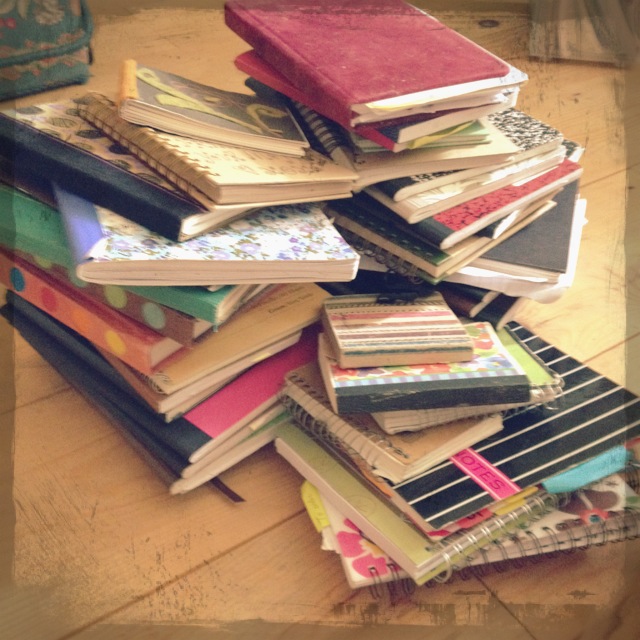
I have at least 30 or 40 notebooks and journals filled with my writing.  They are all over the place.  This is a photo of some of the notebooks that would show up for a portrait.  Others are in boxes, shelves or drawers, or just in hiding.

If you are an avid writer, you know how fast notebooks can fill.

I’ve always struggled with the next step.  A filled notebook.  This treasure. . . where should I put it?

Put it on a shelf. . . or in a box. . . or a drawer. . .

I have been doing some reading lately in a couple of new books on writing.  One book, A Writer’s Book of Days, by Judy Reeves has shifted some thinking in my mind about organizing all these notebooks for actual productivity.

First and most importantly, a writer has to be clear on the kind of writing that the notebook contains.  It could be any of the following:

1.  Journaling

We need to clarify this term.  A journal is a noun, which defines it as a notebook, book or a log.  To journal is a verb, which is defined as to personally record occurrences, experiences, and reflections  on a regular basis.  This is writing that is for self-exploration, self expression and is probably private.  I usually do this kind of writing when I am in deep despair, wrestling with a deeper issue or problem, a catharsis of sorts.  Much of my writing is this.  I start with an issue and answers appear in my writing magically.  No one gets to see this stuff.  I really should burn these notebooks when done purging.  Therapy on a dime.

Journals can also be used as a record keeping device.  My father-in-law has kept journals for years.  He documents daily weather, visits with others, trips, and events of the day.  It amazes me how well the journals can help him remember details from his life.

2.  Morning Pages

I attempt to write every day.  I start where I am and try to fill three pages. I usually do not know where I will start or end up.  I sometimes start with how I have nothing to write about.  The muse almost always shows up and gives me a topic.  Many a day, this writing is blah, blah, blah, just to get writing flowing on a regular practice.  It also helps to diffuse the inner critic.  I don’t care what I write here.  I tell the critic to take a break.  It teaches me to not listen to this gremlin.  I write what I want and see what appears.  Any topic is meat for morning pages.  And, sometimes, morning pages ends up being journaling, although, I try to keep that in separate notebooks now.  Most of my really good ideas come from morning pages.

3.  Writing Practice

This is writing where one tries out a craft or a focused creative writing on a topic.  For me, I love to make captive a powerful sentence and then make it work in my own language with a variety of topics.  Love Love Love mentor sentences.  I think I need to start a menu item of just this.

Writing practice would also include those that like to respond to a prompt and creatively write.  Personally, these feel like fingernails against a chalkboard, but some writers flourish from these.  I’m forcing myself to try them.  All in all, it’s work on craft.

Again, a separate notebook for this.

4.  Project Writing

I typically start a journal just for the collection and writing of a single topic.  All my quotes, thoughts and new understandings about his writing project go into this notebook.  Once I determine a focus for an article, book or idea, I will dump everything to this one place.

5.  And this. . . is the biggie.  Writers notebooks entries.  Beginning writers tend to use the same notebook for everything:   journaling, project writings, writing practice, morning pages – all of it.  That’s okay, at first.  Just getting started writing is a feat in itself.  Applaud yourself if you are writing every day!

However, here is the rub, once you begin focusing on a project or a blog entry later on, and intend on revising and working on craft,  you can never find any snippet of writing that you know you wrote at some previous point in time that would have added that little pizzaz to the writing that you are craving!   I enter this dilemma constantly!

If you have over 25 something notebooks filled with random stuff, including moving quotes, phrases and words to describe a moment, scene or person, you might as well call it a night.  I’m banking that MOST writers don’t magically have this continuous flow of words that stream out of their consciousness like Hemmingway.  Real writers steal.

Seriously.

Read, notice, be astonished, save it for later use.  But tweak it to make it your own.

What to do?

I have decided that I need to have one notebook as my collect-all notebook.   I can capture conversations overheard, like today. . .

I was sitting in the clinic and listening to others sitting in the waiting room.  (I love waiting rooms for this reason.  So much writing material for free.)  This rough looking guy walks by with his jeans all ripped up like has intentions of wearing them that way.  An elderly man sitting next to me, leans over to his wife and says, “Now, what would make a person want to dress like that?” (My dad would say this.)

His wife replies softly, “I don’t know what they’re thinking.” (My mother would say this back.)

I don’t know what I will do with the conversation, but I know that I need to safe-keep it somewhere that is easy to access when I want it.

I stored that tidbit in my main writers notebook.  The “stealth” notebook as Howard Junker, editor of the literary journal ZYZZYVA, calls it.  This notebook will go everywhere with me, so I can capture all those secret bits of ideas, language and noticings and house them for safekeeping.

Later this month, I will do some re-sorting.  I’ll pull out the snatches of words from this main notebook and catagorize them into different notebooks.   I might have  notebook for these catagories:

*ideas for writing (books, articles, blog entries, etc.)

*poetry

*character development (this would include the dialogue snippets and character descriptions)

*five senses notebook organized by the senses (I would capture vivid descriptions here)

*quotes (not sure how I would organize these)

*sentence study (I love to collect cool sentences just because I love how they sound.  Then I try to replicate them using my own content and language.  Way fun. I know, I’m weird.)

I’m not sure what other categories will evolve. This will be a constant work in progress, but my hope is to be able to actually FIND some of the stuff I tuck into my notebooks. Yes, I’ll have notebooks galore, but I do anyway!  At least now, I’m a little more organized and focused on more purposeful writing

I’ll let you know how it goes.  Maybe I’m just dreaming.

So, I’m curious.  What kind of writing do you do?  What kind of notebooks do you use? I’d love to hear! 🙂

Shari 🙂

Why Aren’t I Writing? I Have Some Issues. . .

The first winter storm of the season has arrived to northern Minnesota with a welcoming sense of relief.  The blazing fires just north of us  subsided just yesterday, and the war zone-ish land along with charred buildings and trees can at least be hidden by snow, if only for a brief time, till some of the pain subsides.

School is cancelled.  Inner joy day for me.  This means I have a day to “catch up” at home.  Laundry piled high, dirty bathrooms and a good day for baking. . . but deep down in my core, I’m mostly being called to write.

I have not written on my blog for almost a month.  School started.  Whether a teacher or a literacy coach, the profession is all-consuming.  I vowed not to let this happen, yet I did.

But, today, I have to write.  I’m being given this day.

I’m going to write, I tell myself.

The house quiet, the snow falling.  My notebooks overflowing with some nuggets of gold in there, each screaming to be chosen by me to write about today.

Being given the perfect conditions for a writing day, I am still not writing.

Why, I wonder,  aren’t I writing?  What’s holding me back?

What really IS my problem???

As I ponder this, I’m recognizing the issues.  Several blockades are getting in my way.  The most prominent of these is being a highly sensitive person, not just in an emotional sense, but in all my senses.

First and foremost, a  prerequisite to all of my happiness. . . is heat.  This nosedive to 34 degrees (from 84, just 4 days ago) is a shock to my poptarts.  I gather my belongings (notebooks, books, laptop, tea)  and decide to climb into my warm bed.  I’ll do my writing here.  Getting snuggled in so that napping does not seem more pleasurable than writing is tricky here.  However, I’ve spent many a day writing in bed before, I know it can be done.  A nap later on will probably be necessary from all the hard writing I’m going to be doing.

Set up takes some time. Pillows need to be positioned appropriately.  Is the flat pillow best under my laptop, or none?  If my wrists get sore because they are up too high, I’ll get cranky and stop writing.  I debate. I pull the pillow out.

I need a softer blanket.  This one that covers myself, to keep warm, is stiff and kinda scratchy.  I get up to search for the log cabin quilt that my mother and I made.  The flannel strips, cut from work shirts of my dad’s and my husband’s bring me warmth, comfort and safeness as I cover my lap.  I smile.  K, I’m ready.

Type away, baby!

Let ‘er rip!

Tell that story!

Geez, what IS that smell?

My hyper sensitive nose is a gift, but also a curse.  It can always sense what’s been going on while I’ve been away (gun cleaning on the dining room table, fish cleaning in the kitchen) or not been done (dirty dish rag buried under mountains of dirty dishes, a toilet that needs unplugging).  But, usually, it distracts me from getting things done as when my nose knows there is an issue, it must be solved before I am able to move on to my task at hand.

I decide to get a candle from way upstairs above the garage in my studio.  Citron Basil.  I search for matches and once lit, I gently arrange a spot for it on my night stand.  (First, I am distraught by the newly piled clutter on my nightstand, so I have to clean this off.)  I grab the lavender linen spray and pump a couple of squirts over my bedding.  Both of these, a band-aid approach to the smell, I know.  But, I’m hoping it will detour my nose until my writing is done.

There, now let’s write.  I’m thinking about topic choice today and had planned on writing about the transition from fall to a sudden winter.  Let’s go with that.

It’s really blowing out there now. . . the wind is just a howlin. . .

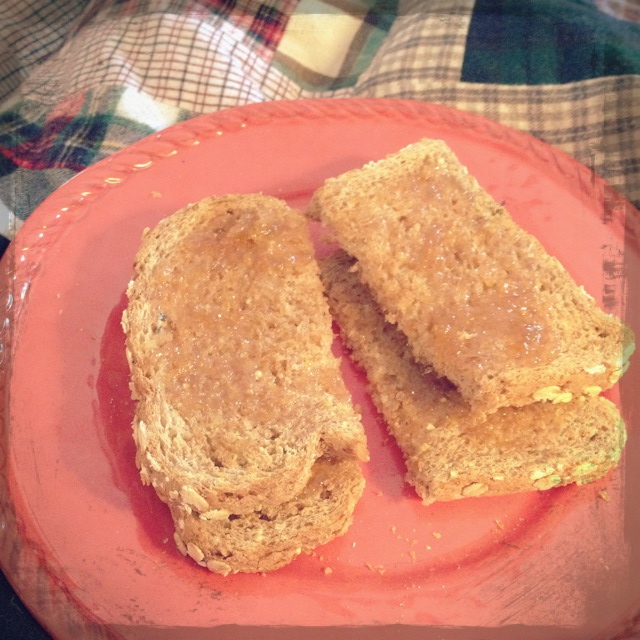
My stomach growls.  Geez, I just ate a couple of hours ago, and I’m already hungry. This is a problem with being at home.  You can satisfy these callings quite easily with a kitchen at hand.  I climb out of bed, hike off to scrounge up some food and settle on a couple of slices of toast with some sensuous farmer’s market orange rhubarb jam.  Mmm. . . better get some more tea, too, while I’m here.  Save time.  I can’t be wasting time, you know.

I settle back into bed and am a little perturbed that this annoying scent is back.  It smells of someone who hasn’t taken a bath for quite some time.  It’s gotta be my sheets.  I get up and strip the bed.  Take all the pillow cases off the pillows (all 7 of them, yes, I sleep with 4, husband with 3, that’s another story).  I dig for new sheets and cases and make the bed so all is fresh.  Quilts back on.  Perfect.  Gotta love fresh bedding.

Now, where the heck was I?  For Pete’s Sake.  It’s already 9:30.

The front door slams out front.  My 19-year-old daughter enters from her 5:30 shift as a waitress.  She is giddy with glee because of the snow.  She allows Sandy in and they are both gallivanting throughout the house like a houseful of children at a birthday party.  After a small tornado in the kitchen, from her breakfast creations, she barrels into my bedroom to voice that she is NOT happy because the college has decided NOT to cancel classes and my school has.

“I can’t help that, hon,” I say.

“Well, it’s not fair!”

She packs up her backpack and hikes off to her politics class.

I shoo Sandy back outside.

All I can think is, “Thank the Universe for not canceling college today.”

Back to writing.  Now, you’d think I’d be giving up by now, but no.  I have all day.  I carry on.  I’m just not a quitter, you know.

It’s still quite chilly in my bedroom and my fingers begin that numbing whine of, “I can’t do this anymore until you get me some heat.”  Ughh.  I check the thermostat and notice it was turned down to 67.  67!  Now, this can only be the work of my husband who is highly conservative when it comes to heat.  I decide to crank it up.  Just for a while.

Up in my studio above the garage is also a little space heater.  I decide this is a necessary device for my bedroom this morning just to give it a little head start since the heat will take a little while to kick in.  I also change my socks.  I figured that it’s time to dig out my Smart wool.  My ankles were a little frosty.

It’s toasty now.  My fingers will be happy.  I won’t be, though, if they don’t produce something here.

I carry on, but more of the same ensues.

The front door slams again and Gracie barges back into my bedroom.

“Class was cancelled!”

“Haha.” I chuckle.

“There was a sign on the classroom door.  I don’t know why she couldn’t have emailed us!  Oh well, I’m gonna clean my room today, and Sandy’s gonna help and then I’m gonna make Pumpkin Spice cookies and decorate them with orange cream cheese frosting!”

Off she skips.

Oh my.  Expect kitchen clean up later.

And on it continues. . .

A large oak tree branch from a dead tree falls on the roof with a crash.  I have to get up and seek out the damage.  Squirrels outside my window are digging ferociously for acorns now buried under the new blanket of snow.  I watch this for a while and wonder when they will have enough stored up.  Music is now blaring from Gracie’s room.

I really need to get some decent writing done.

My fingers are just weeping at what is coming out.

Maybe it will quiet down around here later on.

Maybe I should do laundry.

Then. . . the power goes out.

I take a nap.  It’s a good day for a nap.

Maybe I’m not supposed to write today.

Ann Cameron calls this procrastination.  Steven Pressfield says it’s resistance.  Nancy Slonim Aronic:  lack of discipline.  I say it’s all of the above, with a touch of ADD.

All I know is that I had most of my day to write, and I didn’t write much.

Well, I did write this post.  I guess that’s something.

Again, my fingers weep at what comes out.

5 Powerful Reasons You Need Morning Pages in Your Life

Morning Pages image

I have done morning pages most of my life, way before Julie Cameron wrote about them in her book The Artist’s Way back in 1992.  When I first read The Artist’s Way for the first time in 2006, I smiled.  What I was doing now had a  name.

I have at least 50 notebooks filled with writing.  Probably more.  They are everywhere. Somedays I write 10-15 pages, others my mandatory 3.  Whatever it may be, I have to write.

I stopped doing morning pages when I started my blogs. 

Why?  How can someone who has done something for a life time stop doing something that is so engrained in their being?  What could possibly cause this?

I started using my blog AS my morning pages.  

Instead of going to the notebook and pen in the mornings, I was now going to my computer attempting to compose a writing for an audience.  I fretted over the frustration of topic choice, choosing a catchy title, crafting that first lead sentence that hooks and then always trying to keep a focus and stick to some pain points.

A  blog has a distinct structure that you try to attain.  This is not morning pages.  I was at a creative standstill.  A block.  Some days I just sat at my computer and pondered.

I didn’t write.  I wasn’t writing.

Julie Cameron’s book Walking in This World arrived on by doorstep yesterday.  As I leafed through the first pages, she reviews the “Basic Tools” for any creative soul.  Morning pages were right there, on the page, as the first, most powerful tool.

I love it when you know something so deep in your core and your veer from it for some reason or another and then, all of a sudden, the Universe sends you a little reminder that you need to remember to do what you know.  Gives me chills.

So, I’m back to my morning pages again. 🙂

Why are morning pages so powerful, you ask?

Well, I’ll give you 5 really big reasons.

1.  There is no wrong way to do morning pages.

Morning pages are at least 3 pages of long hand writing (no computer) in a notebook that is free-flowing stream of conscious writing.  They are not meant to be art or even any good.  Not that they might be.  They could.  They are only meant for your eyes.  No audience.

2.  The drama gets put on the page.

Julie Cameron says, “All that angry, whiny, petty stuff that you write down in your morning pages is the stuff that stands between you and your creativity.”

It might be worry over bills.  It might be anger at your husband.  It might be you beating yourself up because you drank too much last night.

Whatever this is, it’s drama.  If you get it on paper, it’s leaked out of you.  You did something with it.  So, you can move on.

If I can get my drama on the page, I have less drama in my life.  My head is clearer and I can focus my thinking on the things I want to focus on.

3.  Morning pages teach us to get beyond our critic in our heads.

Because there is no wrong way to do the morning pages and we can write whatever we feel and not care what it says or how it looks, we have the right to ignore the critic in our brain telling us that our writing (or anything else for that matter) is crap.

“We have a logic brain.  This is our Censor that gives us our second, third and fourth thoughts whenever faced with our own original thoughts,”  writes Julia.  Quite often, it spits at us words like, “You can’t write that!” or “Who are you kidding?”

And we have our artist brain.  This artist brain is our creative being.  It has glorious thoughts of “what-if’s” and sees a beautiful leaf and thinks, “I’m going to press leaves and string a bunch of them together to make a leaf garland and hang it above my kitchen window!”  Artist brain is random, free and idealistic.

Julie proclaims that “morning pages teach logic brain to stand aside and let artist brain play.”  Why is this important?  I don’t know about you, but my logic brain is dominant in my brain 24/7.  I know I need to train it better.

4.  Morning pages are a form of meditation.

If we write enough so that it feels like breathing, we begin to see new insights in our writing.  We see the same issues, read over the continued whining and we realize that we need to make changes.

In my own life, the answers to my questions magically appear in my writing.  Many times I have stopped in my own tracks and looked at what came out and cried.  God speaks to us through our writing.

We meditate to discover who we are.  To listen to the whispers from God.  Writing is a form of meditation and the great power in it, more so than meditating without writing, is that the writing that ends up on page helps us to map our pathways.

It is almost impossible to write your morning pages morning after morning without feeling a divine unexpected inner guidance.

I consider it a gift.

5.  Morning pages are not just for writers.

Morning pages are for everyone.  If you know how to hold a pencil and scribble some letters, you can do morning pages.  We all have inner work to do.  Every soul is searching for something.  We all are praying for answers.

Everyone can find them in our pages.

If you haven’t written for a while, go buy a cheap composition notebook and find your favorite pen.  Set your alarm for a half hour to an hour early and start your pages.

Write anything. Write about how you don’t know what to write.

Just get it on the page.

Shari 🙂

Disappearing to Lose My “Self”

I dropped from the face of the earth for awhile.  I was blessed enough to stay at a primitive, secluded cabin on a remote pond in northern Minnesota for two entire weeks this past month.

This was not a family vacation.

It was time for me.  Selfish.  Maybe.  I was tired of putting myself at the bottom of my priority list.  I had the opportunity so I flung myself at it.

During this time, I filled an entire 246 pages of paper with words.  Every day, I wrote, I read, I wept, I snapped pictures, I observed, I sketched, I was still, I listened, I wept,  I prayed, I meditated, I sang, I danced, I swam, I walked, I napped, and I just sat and pondered.

Did I mention that I wept?  More than once.  I brought myself to places I had not been able to get myself to in years.  I came to this cabin as one person. . . and left another.

This morning, I am looking through my notebook of these writings and it’s all flooding back.  Tears flood as well.  The magic of words.  They carry so much weight.  So much self discovery, so much learning, so many lessons.

I have to write about it here.    I have to share them, each page of words. . . a gift to me.  They touch me deeply.  I can’t leave these angel messages closed in this notebook and move on to other present moment experiences and thoughts.  I come to my desk every  morning and see that black leather bound journal with the broken spine and 246 pages full with stickies poking out of it sitting there on my pile of notebooks and it keeps pawing at me.  Like a puppy in church.

Today will be a day for reliving those words in my mind.  Feeling them again.

Monday will begin my story of Arrival Day At the Cabin and the person that was.

Shari 🙂